The ACC Commission has agreed to give $150,000 to the Food Bank of Northeast Georgia as some Athenians continue to wonder when they will receive food assistance benefits this month.
At their meeting on Tuesday, the commission also delayed approval of a controversial student apartment complex near Lay Park and authorized spending over $10 million on maintaining local roadways – about $4 million short of the amount needed to prevent further deterioration.
Contents
Funding the Food Bank of Northeast Georgia
Decision on student apartments delayed
Pavement maintenance
Funding the Food Bank of Northeast Georgia
A food emergency is spreading across the Athens area in the wake of the federal government’s freeze of Supplemental Nutrition Assistance Program (SNAP) food assistance benefits this month. According to Erin Barger, President and CEO of the Food Bank of Northeast Georgia, the unmet need may even be higher now than during the height of the COVID-19 pandemic.
“Our neighbors are experiencing food insecurity at a level greater than I’ve ever seen before,” Barger told APN. “During the pandemic, SNAP benefits were increased and there were various opportunities available to people at that point. But today, food insecurity continues to climb while the safety net has eroded.”
SNAP benefits were temporarily halted on November 1, a casualty of the ongoing federal government shutdown. While the US Department of Agriculture (USDA) has $6 billion available for SNAP in an emergency fund, the department originally said that it would not use the money to keep SNAP benefits flowing this month. In defense of their residents, a coalition of states sued the federal government and forced the money to be allocated. The USDA now says that SNAP recipients will get 65% of their normal benefits for November at most, but this is a developing story and it is still unclear when these benefits will arrive for hungry Athenians.
“At the current moment, it is unknown when SNAP benefits will be reactivated,” Barger said. “There have been conversations at the federal level about partial funding, but no changes have occurred yet. There likely won’t be a full return of benefits until the shutdown ends.”
SNAP benefits come from the federal government and are distributed by the Department of Human Services in Georgia. Benefits arrive on recipients’ cards throughout the month, normally from the fifth through the 23rd. This means that some Georgians have not yet experienced any delay and can continue to use the remaining funds on their benefit cards as normal.
However, the “normal” that SNAP recipients have come to expect is far from perfect. In August, a cyberattack shut down call centers in Georgia, greatly hindering many from accessing their SNAP benefits for months. Now, benefits have been halted without any clarity on when they will resume – just as the holiday season is about to begin.
“There has been an erosion of trust in the SNAP system,” Barger said. “What is clear is that the food bank will be relied upon even more than it was last month. Even if benefits are reactivated quickly, that would be in the middle of the month. People need to eat today. They need to eat tomorrow. We want folks to know that we’re here for them.”
17% of Athens residents rely on SNAP to afford food, according to data from the Athens Wellbeing Project, an initiative of UGA researchers that gathers community data to assist policymakers. Even when SNAP is fully funded, 16% of Athens residents reported going hungry at least once last year and 33% report being unable to afford balanced meals.
Researchers with the Athens Wellbeing Project wrote in a press release that “the loss of SNAP and WIC [a food assistance program designed for Women, Infants and Children] will have cascading effects across the social determinants of health … Research consistently links food insecurity to higher rates of emergency room visits, chronic disease exacerbations and housing instability.”
While the food bank’s efforts are essential, the Athens Wellbeing Project warns that it cannot meet the need alone if SNAP benefits are not reactivated.
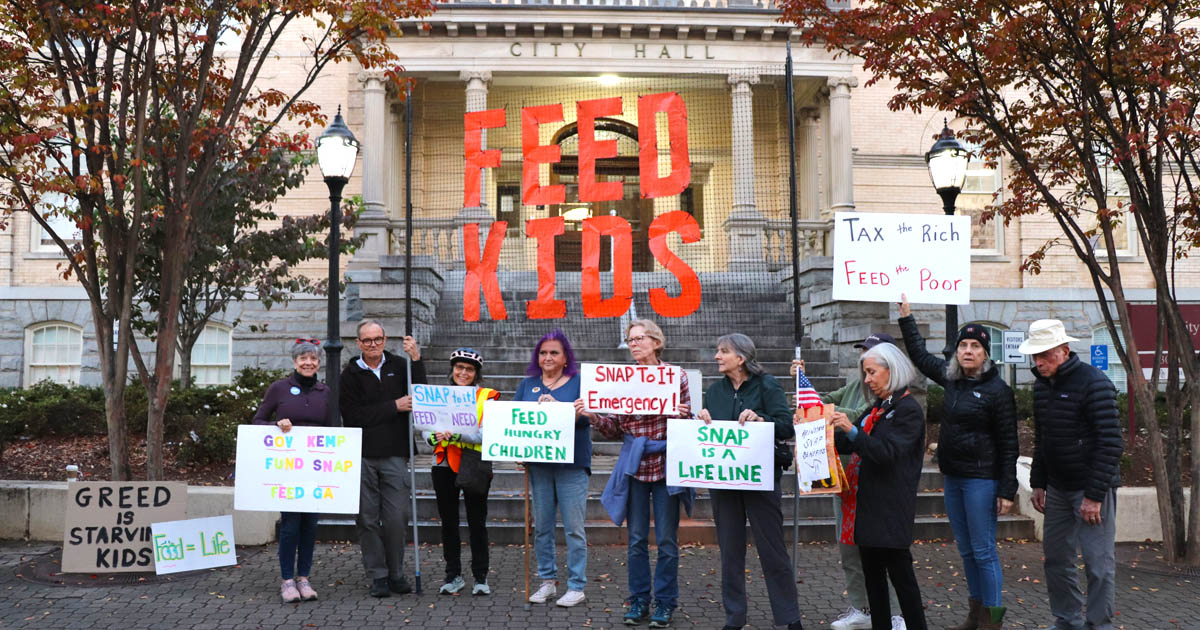
ACC Commissioners voted unanimously to contribute $150,000 from their 2026 contingency fund to the Food Bank of Northeast Georgia after hearing from a number of concerned residents during public comment.
“We’re calling on our local and state leaders to explore every possible solution to protect Athens families impacted by the SNAP freeze and the ongoing government shutdown,” Mokah Jasmine Johnson, co-founder of the Athens Anti-Discrimination Movement, told commissioners. “We thank you for bringing this to the table and for taking action in such a short period of time, but we’re also here to ask you to do more … What do we do after the $150,000 in local aid is spent?”
The Food Bank of Northeast Georgia said in a press release that they were “already racing to meet the need for food” before the government shutdown began. After SNAP benefits were cut, the food bank increased food purchases by 400% to keep up with anticipated demand. The local government’s $150,000 contribution will make up 30% of the food bank’s $500,000 shortfall.
If you are experiencing food insecurity, there are a number of upcoming food distribution dates in the Athens area, as reported in the Flagpole.
If you would like to support the Food Bank of Northeast Georgia, you can do so here.
Decision on downtown student apartments delayed
The ACC Commission narrowly decided to delay their decision on whether to support the construction of a large new student apartment complex near Lay Park and the Foundry in downtown Athens. If eventually approved, this development would proceed in partnership with the Athens Downtown Development Authority and a Chicago-based developer, Core Spaces, LLC.
In exchange for two oddly-shaped parcels of government-owned land that are difficult to build on, Core Spaces would pay for almost half of a new parking deck on Hoyt Street which has been long desired by the Athens Downtown Development Authority. The local government would also receive $4.7 million for the land, a $7.8 million contribution to the affordable housing trust fund and a $2.5 million upgrade to the north downtown sewer system as part of this project.

Based on these numbers alone, the project may be difficult for commissioners to refuse. Athens is facing a large unmet infrastructure maintenance need over the long-term (see below) and desperately needs a way to raise money beyond increasing the property tax burden on existing homeowners.
Yet, the project may also be a tough one for some commissioners to accept. Commissioners Dexter Fisher, Tiffany Taylor and others expressed concerns about potential impacts to Lay Park’s operations after the parking lots that serve the area are destroyed. A new parking deck will be built with free spaces available for park-goers, but it will be further away from the park than existing lots. More importantly, some commissioners fear that nearby Black residents may no longer feel welcome in the area after a further influx of thousands of UGA students, who are predominantly white.
Discomfort about Athens’ future and what the development might mean for Black residents was evident in Taylor’s comments particularly.

“We are so overwhelmed with students living in our community that there ain’t even going to be anywhere for us to build affordable housing [even with the $7.8 million contribution]. Private developers are buying up those parcels five at a time,” Taylor said. “Lay Park is going to be overrun with students and there isn’t going to be anyplace for the children in Bethel Homes [to play] … We’re allowing people to come in and push us out.”
Fisher asked for the vote to be delayed so that commissioners could hear a full presentation from ACC staff about the development. A presentation was already given last month but Fisher says it did not mention the impacts the development might have on Lay Park programming.
Commissioner Mike Hamby objected to Fisher’s call for delay, saying that the additional time would not change anyone’s mind. Hamby motioned for the commission to approve the project, but this vote failed 4-6. Commissioners Allison Wright, Melissa Link and John Culpepper joined Hamby in voting for approval.
Then attention returned to Fisher’s motion to delay. That passed 8-2, with only Hamby and Wright voting against it.
The work session requested by Fisher will take place in December.
[CORRECTION: This article originally stated that the work session would take place in November, but it appears the date has been moved back to December.]
Pavement in Athens continues to deteriorate despite millions spent
The ACC Commission unanimously authorized the spending of $10.7 million to improve the condition of over 100 miles of locally-owned roads in Athens. 47 miles will be resurfaced and another 54 miles of roadway will receive preventative care if Athens receives a maintenance grant from the state government this year as expected.
Unfortunately, $10.7 million is not enough to prevent roadways across Athens from starting to crumble due to constant use. While TSPLOST 2023 earmarked $21 million for pavement maintenance and additional funding is also available from the county’s general fund, TSPLOST 2018 and the state government’s local maintenance improvement grant (LMIG), none of this is enough to meet the need.

ACC staff estimate that $14.8 million would be required each year to maintain the current, somewhat compromised condition of Athens’ roads. An eye-popping $45 million would be needed, if this estimate is correct, to start reversing the long-term trend and bring our roadways back up to “very good” condition on the pavement condition index (79 points out of 100).
You can check out the commission’s agenda item if you’d like to see a full list of the roadways to be resurfaced this year.
Help APN continue covering local news for the Athens area!
Please consider becoming a member or giving a one-time donation via PayPal.